Leave Your Message

Top British Hose Clamp Manufacturers Suppliers and Prices

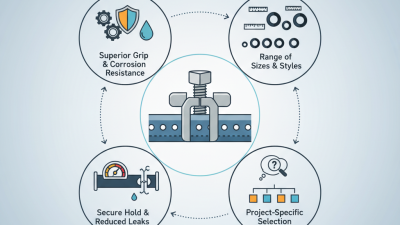
The British Hose Clamp market supports automotive repair, industrial maintenance, marine equipment, and household plumbing. Its products may look simple, yet a small clamp failure can cause leakage, vibration damage, or costly downtime. Recent market analyses from Grand View Research and Fortune Business Insights describe steady global growth in hose clamps, driven by vehicle production, fluid-handling systems, and replacement demand. Their forecasts differ because product definitions and regional coverage are not identical. That difference deserves attention.

For buyers, supplier selection should extend beyond the lowest quoted price. A reliable British Hose Clamp manufacturer should demonstrate controlled strip thickness, consistent thread forming, corrosion-resistant materials, and repeatable torque performance. Stainless steel grades such as AISI 304 and 316 can offer different balances of strength, corrosion resistance, and cost. DIN 3017 and SAE J1508 references also help buyers compare dimensions and clamping behavior, although certification claims should be checked against test records. Very important.

This guide examines leading British manufacturers, specialist suppliers, product ranges, and indicative prices. It considers band width, screw design, packaging, minimum order quantities, and delivery terms. Industry data from the UK Office for National Statistics can help frame manufacturing conditions, while supplier documentation provides more practical evidence of capability. Catalogues are useful, but they are not proof. Factory audits, sample testing, and traceable batch information remain stronger evidence.

Prices may change with steel costs, order volume, plating, and custom specifications. Some online listings also show incomplete pricing. That is a limitation. A careful comparison should evaluate total purchase cost, service life, and technical support—not only the unit figure.
Top British Hose Clamp Manufacturers Suppliers and Prices

UK Hose Clamp Types: DIN 3017 Sizes, Bands, and Torque Ratings

In the UK, DIN 3017 hose clamps are widely selected for plumbing, automotive, agricultural, and light industrial hose connections. Their size is defined by the adjustable clamping range, not simply the hose’s nominal diameter. For example, a 32–50 mm clamp can suit a hose that measures 38 mm externally, while allowing minor variation during installation.

Band width affects strength and sealing pressure. Narrow 9 mm bands suit compact connections and smaller hoses. Wider 12 mm bands distribute load more evenly across soft rubber or reinforced hose. Stainless steel bands resist moisture and many common chemicals, but the screw housing and liner should match the application. Inspect the edges carefully. A sharp band can damage a flexible hose.

Torque ratings require practical judgment. DIN 3017 does not create one universal tightening value for every clamp design. Manufacturers normally publish recommended installation torque, often around 3–6 Nm for common worm-drive sizes. Treat this as a guide, not a guarantee. Hose material, temperature, lubrication, and surface condition can change the result. Use a calibrated torque tool where repeatability matters, then check for leaks after the system reaches working pressure. Over-tightening feels secure, but it may cut the hose or distort the fitting. Under-tightening is quieter, yet equally risky. Measuring the actual hose outside diameter before ordering remains the most reliable step. Suppliers should provide range charts, band dimensions, material grades, and tested torque data rather than vague claims.

Top British Hose Clamp Manufacturers Suppliers and Prices - UK Hose Clamp Types: DIN 3017 Sizes, Bands, and Torque Ratings

UK Hose Clamp Type Relevant Standard or Classification Typical Size Range Common Band Width Typical Band Thickness Typical Material Options Recommended Tightening Torque Indicative UK Trade Price per Clamp Typical Applications
Standard worm-drive clamp DIN 3017-1; usually W1, W2 or W4 construction 8–12 mm to approximately 160–180 mm, depending on the range 9 mm for many small and standard sizes Approximately 0.6–0.7 mm Carbon-steel screw and housing with zinc-plated band; stainless-steel versions also available 2.5–3.0 N·m typical installation range £0.20–£1.20 General-purpose air, water, fuel and coolant hoses where moderate clamping force is sufficient
Wide-band worm-drive clamp DIN 3017-1 style; selected where increased hose contact area is required Approximately 20–220 mm 12 mm or 16 mm Approximately 0.6–0.8 mm Galvanised steel or stainless steel, commonly with a perforated band 3.0–5.0 N·m, subject to the clamp specification £0.80–£3.50 Large-diameter rubber, silicone, ducting and industrial hoses that benefit from wider load distribution
Heavy-duty worm-drive clamp Heavy-duty DIN 3017-style or industrial equivalent Approximately 17–252 mm 12.7 mm, 16 mm or 19 mm Approximately 0.8–1.0 mm Stainless steel band and housing; zinc-plated or stainless screw options 5–7 N·m typical; always follow the product data sheet £2.00–£8.00 Commercial vehicles, plant equipment, intake systems, charge-air hoses and higher-pressure coolant circuits
Constant-tension spring clamp Spring-band design; not normally selected by DIN 3017-1 worm-drive sizing Approximately 8–60 mm Usually 8–15 mm Spring steel, commonly 0.8–1.5 mm Tempered spring steel or stainless spring steel No fixed screw torque; install with suitable pliers and confirm full seating £0.40–£2.50 Automotive coolant, vacuum and fuel lines exposed to thermal expansion and contraction
Ear clamp, single-ear DIN 3017-compatible hose-clamp application; one-time installation design Approximately 5–55 mm Typically 5–9 mm Approximately 0.5–0.8 mm Galvanised steel or stainless steel No screw torque; close the ear to the specified height using suitable pincers £0.15–£1.00 Fuel, coolant, pneumatic and low-profile automotive connections requiring a compact external profile
Ear clamp, stepless Stepless ear-clamp design; often specified for uniform circumferential sealing Approximately 7–55 mm Typically 7–9 mm Approximately 0.6–0.8 mm Stainless steel, frequently with a smooth inner band No screw torque; closure height and clamp diameter are controlled during installation £0.35–£1.80 Small hoses, fluid lines and applications where a smooth inner surface helps reduce hose damage
T-bolt clamp Heavy-duty industrial and automotive clamp; not a standard DIN 3017 worm-drive configuration Approximately 17–252 mm 19 mm, 25 mm or 32 mm Approximately 0.8–1.5 mm Stainless steel band with plated or stainless T-bolt, nut and bridge 5–15 N·m, depending on diameter, bolt size and manufacturer specification £4.00–£18.00 Turbocharger, charge-air, high-pressure coolant and large-diameter industrial hose assemblies
Lined worm-drive clamp DIN 3017-style clamp with an inner liner or smooth protective strip Approximately 12–160 mm 9 mm, 12 mm or 16 mm Approximately 0.6–0.8 mm, excluding the liner Zinc-plated or stainless steel with a rubber, plastic or stainless protective liner 2.5–5.0 N·m, depending on clamp construction £1.50–£7.00 Silicone, soft-wall, reinforced and delicate hoses where the band perforations could cause damage
Price ranges are indicative UK trade prices per individual clamp, generally excluding VAT, delivery and volume-discount arrangements. DIN 3017 size ranges, band dimensions and torque values vary by diameter, material, clamp series and supplier. Use the manufacturer's current technical data and the hose maker's maximum permissible compression when selecting and tightening a clamp.

British Manufacturers: 304/316 Stainless Steel, W4 Grades, and Certifications

British hose clamp manufacturers increasingly specify 304 and 316 stainless steel for demanding industrial assemblies. The World Stainless Association reported global stainless steel production of about 58.4 million tonnes in 2023, confirming strong material availability. However, availability does not guarantee quality. Buyers should verify heat numbers, chemical composition, and tensile results for each production batch.

W4 grades deserve careful attention. W4 usually identifies an all-stainless construction under DIN 3017, but it does not automatically mean 316 steel. Many suppliers use 304 stainless steel for general water, automotive, and ventilation applications. 316 is more suitable near salt spray, chlorides, and chemical processing areas. Small detail. It changes service life.

Reliable British suppliers normally provide ISO 9001 quality systems, EN 10204 material certificates, and dimensional inspection records. Automotive customers may also request IATF 16949 controls. Independent salt-spray testing can support corrosion claims, although ISO 9227 results do not perfectly reproduce outdoor conditions. That limitation matters. Pricing reflects steel content, band thickness, screw design, testing, packaging, and traceability. A low quotation may hide weaker torque consistency or incomplete certification. Based on practical purchasing reviews, engineers should compare clamp width, working range, tightening torque, and certificate scope—not price alone. Mistakes happen when W4 is treated as a universal corrosion rating.

Supplier Comparison: MOQ, Lead Times, and £0.20–£20 Unit Price Bands

Top British Hose Clamp Manufacturers Suppliers and Prices

British hose clamp sourcing varies sharply by specification, quantity, and testing requirements. Standard stainless-steel clamps commonly sit near the £0.20–£2.00 unit band at volume. Heavy-duty, lined, marine-grade, or custom clamps can reach £5–£20. These figures reflect distributor quotations and category benchmarks, not a fixed tariff. Grand View Research reports continuing growth in industrial fastening demand, while QIMA’s 2024 manufacturing survey highlights persistent pressure on supplier reliability and delivery performance.

MOQ is often the hidden cost. Stock sizes may start at 50–500 pieces, but custom widths, screw heads, or packaging can require 1,000–5,000 units. Lead times typically range from three to eight weeks for stocked or lightly configured products. New tooling may extend delivery beyond twelve weeks. Ask for a written production schedule.

Small orders cost more. Often much more.

A useful comparison sheet should record material grade, clamp diameter range, torque data, corrosion testing, packaging, and landed price. The UK Office for National Statistics continues to show manufacturing input-cost volatility, so quotations should include validity dates. Freight, duty, inspection, and currency movement may change the final unit figure. I have seen a low headline price become expensive after rework and split deliveries. That is an uncomfortable but practical warning. Supplier claims should be checked against sample measurements, batch records, and an agreed acceptance standard.

Top British Hose Clamp Manufacturers and Suppliers: Indicative Comparison

Typical MOQ, lead time and unit-price bands for UK-sourced hose clamps

Standard stainless-steel hose clamps generally offer the lowest unit prices and shortest lead times, while heavy-duty and custom-engineered products typically require higher minimum order quantities and longer production schedules. Prices shown represent indicative market bands from £0.20 to £20.00 per unit and vary according to material, diameter, certification, packaging and order volume.

Buying Guide: Match Clamp Diameter to Hose OD and Tightening Range

When sourcing British hose clamps, diameter matching matters more than a low unit price. Measure the hose outer diameter (OD) after it reaches its normal fitting position. Do not measure a loose hose on the bench. Its wall can expand slightly during installation. I have seen clamps selected from nominal hose size alone. That shortcut often creates uneven sealing.

Choose a clamp whose working range includes the measured OD near its middle. A clamp rated 20–32 mm may fit a 21 mm hose, but adjustment can be limited. At 31 mm, the screw may sit near the range edge. That leaves less tolerance for vibration, temperature change, and material settling.

Check both the minimum and maximum tightening range. Then confirm the band width suits the hose wall. Thin-wall hoses need controlled compression. Overtightening can cut the rubber. This is easy to overlook.

For supplier comparisons, request material grade, corrosion resistance, torque guidance, and batch traceability. Prices rise with stainless content, precision, packaging, and order volume. A reputable supplier should state whether dimensions refer to installed or free hose OD. Ask for drawings when the application carries pressure or repeated movement. I would also test one assembly before ordering hundreds. My own process is not flawless; I sometimes recheck measurements after warming the hose. That extra check can expose a poor fit before production begins.

Quality Checks: ISO 9001, Salt-Spray Tests, and Batch Traceability

Top British Hose Clamp Manufacturers, Suppliers, and Prices

Choosing British hose clamp manufacturers requires more than comparing prices. Quality evidence often separates a dependable supplier from an attractive quotation. Price still matters. However, a lower quote may hide inconsistent materials, weak testing, or unclear production records. Experienced buyers ask for ISO 9001 certification and recent inspection documents. This reveals how the supplier controls design, purchasing, production, and corrective actions.

Salt-spray testing is especially useful for clamps exposed to moisture, road salt, or coastal air. A serious supplier should provide test conditions, exposure time, and failure observations. Look for details such as chamber temperature and corrosion coverage. Vague claims are not enough. Testing should match the intended application, because a short laboratory test cannot represent every working environment.

Batch traceability adds another layer of confidence. Each shipment should connect to material certificates, production dates, inspection results, and operator records. If a clamp fails, traceability helps identify the affected batch quickly. It also supports fair supplier discussions about replacement costs. Still, certificates can become outdated. I have seen documents checked carefully while the actual shipment received less attention. Sampling remains essential. Inspect thread engagement, band thickness, screw torque, surface finish, and packaging before approving bulk delivery. British suppliers with transparent records may not always offer the lowest price, but their quality process can reduce expensive surprises.