Leave Your Message

How to Choose the Right Riser Clamp for Global Projects?

Choosing the right Riser Clamp for global projects requires more than matching pipe diameter. It requires engineering judgment, verified data, and careful attention to local conditions. A clamp that performs well in a dry plant may fail prematurely near a coastal installation. Corrosion changes everything.

Roy A. Parisher, a respected piping-design author, emphasized, “Good piping design begins with understanding the forces, not merely drawing the lines.” This principle remains useful when selecting a Riser Clamp. The clamp must safely transfer vertical loads into the structure. It must also control movement without damaging insulation, coatings, or the pipe wall.

Start with the actual load path. Check pipe weight, fluid weight, thermal expansion, vibration, seismic forces, and installation tolerances. A stainless-steel pipe may need different contact protection than a carbon-steel riser. A fire-protection system may also demand specific approvals and spacing rules. Do not rely on a catalog image alone.

Material compatibility matters. Galvanized hardware beside untreated carbon steel can create problems in humid environments. Small details matter. Drainage, coating thickness, bolt access, and inspection clearance should be reviewed before fabrication. The best design on paper can become difficult on a crowded construction site.

Global projects add another layer of risk. Standards, certification practices, and structural requirements differ between regions. Confirm the applicable project specifications and consult qualified local engineers. Honestly, no selection guide can remove every uncertainty. Field measurements may be incomplete. Supplier data may need clarification. That is why a documented review, physical fit check, and realistic installation plan should accompany every Riser Clamp decision.
How to Choose the Right Riser Clamp for Global Projects?

Define Riser Clamp Types and Their Global Applications

Riser clamps support vertical pipe runs while transferring weight to structural floors or frames.
The common two-piece clamp suits water, HVAC, and utility risers. A hinged clamp speeds installation where access is limited. Heavy-duty welded or reinforced clamps serve larger process pipes. Insulated versions reduce thermal bridging and protect coated pipe surfaces. Guide clamps control movement without carrying the full vertical load.
That distinction matters.

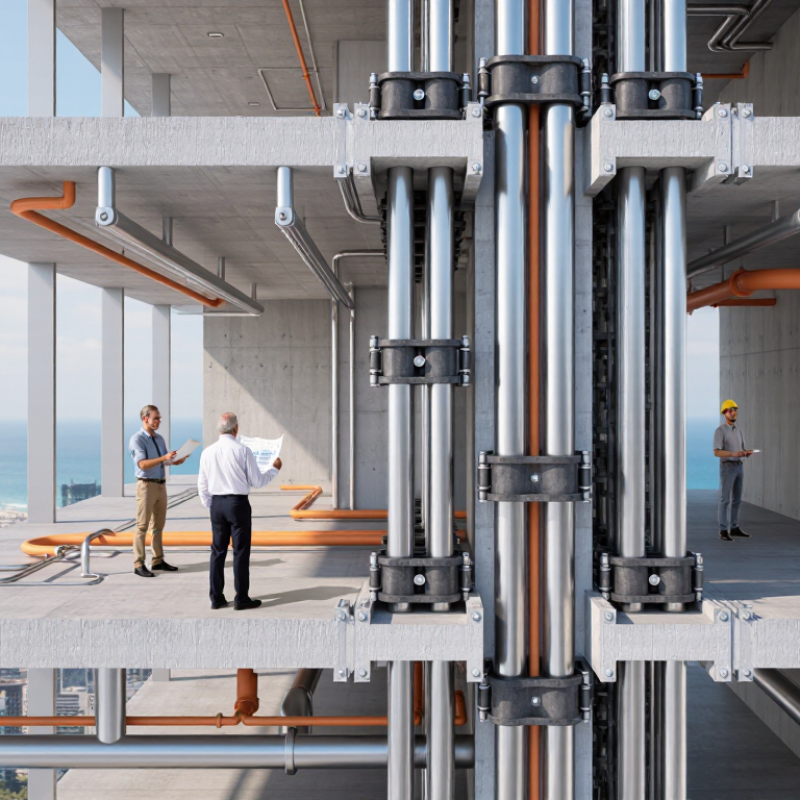
Global projects need more than a catalog size. In high-rise buildings, clamps must coordinate with concrete inserts, fire-rated shafts, and restricted maintenance space. District-energy systems may need thermal expansion control across long vertical routes.

Process plants often require corrosion-resistant materials and documented load calculations. Seismic projects may add lateral restraints, especially in regions governed by ASCE 7 or comparable local rules. ASME B31.1, ASME B31.3, EN 13480, and regional fire codes can change the selection basis.
One detail is easily missed: pipe insulation thickness can alter the clamp’s actual fit.

The International Energy Agency reported in World Energy Investment 2024 that global energy investment would exceed 3 trillion dollars, with about 2 trillion directed toward clean energy. That expansion increases demand for reliable piping supports in power, cooling, hydrogen, and utility projects.
However, market growth does not remove engineering uncertainty. A clamp rated for static load may not suit vibration, thermal movement, or seismic forces. Project teams should verify load paths, bolt grades, surface protection, temperature range, and installation torque.
A perfect drawing can still meet a poorly prepared wall.
Assess Pipe Loads, Dimensions, Materials, and Operating Conditions

Choosing a riser clamp starts with the pipe load, not the clamp catalog. Calculate the combined weight of the pipe, fluid, insulation, valves, and test water. Hydrostatic testing can add substantial temporary load. ASME B31.3 requires piping design to consider pressure, weight, thermal expansion, and occasional loads. A 12-meter carbon-steel riser filled with water may weigh several tonnes. Small errors become serious at upper supports.

Dimensions need equal attention. Measure the outside diameter, wall thickness, clamp contact width, and available clearance. Do not rely on nominal pipe size alone. A clamp that fits a 219-millimeter pipe may fail around a coated pipe with a larger finished diameter. MSS SP-58 provides guidance for pipe supports and load-related design considerations. Local wind and seismic data also matter. A riser in a coastal tower faces different forces from one inside a protected plant.

Material selection follows the operating environment. Carbon steel, stainless steel, lined pipe, and insulated pipe require different contact surfaces and corrosion controls. Thermal movement is easy to underestimate. For a 30-meter steel riser, a 100°C temperature change can create roughly 36 millimeters of expansion, using a coefficient near 12 × 10⁻⁶/°C. Stainless steel may move more. Check friction, guides, anchors, and sliding points together. Field reviews often expose an uncomfortable truth: the clamp was correct, but the support spacing was not. Recheck the assumptions.

Match Clamp Design with Regional Codes and Project Standards

A riser clamp is not a universal component. Its design must follow regional codes, project specifications, and actual site conditions. The International Energy Agency’s World Energy Investment 2024 report estimates global energy investment will reach more than 3 trillion dollars in 2024. Large projects cross more jurisdictions. Small code differences can create serious installation delays.

For process piping, compare requirements from ASME B31.3, EN 13480, or the governing local code. Check vertical load, thermal movement, vibration, seismic forces, and fire exposure. MSS SP-58 provides useful guidance for pipe supports and hanger materials. However, a clamp accepted in one region may not satisfy another project’s inspection rules. Confirm material grades, welding procedures, corrosion protection, and required calculations before procurement. Do not rely only on a familiar drawing.

Tips: Build a regional compliance matrix. List every code, test, coating, and approval. Ask the structural engineer to verify anchor loads and building interfaces. Request evidence for load testing and material traceability. Leave adjustment space for field tolerances. It matters.

A practical review should include real installation details. Measure pipe insulation thickness, access clearance, and expected movement. In field coordination, teams sometimes select a strong clamp that cannot close around the finished insulation. That mistake is avoidable, but design assumptions are often incomplete. Recheck them.

Verify Corrosion Resistance, Installation, and Maintenance Requirements

How to Choose the Right Riser Clamp for Global Projects?

A riser clamp must resist its actual environment, not an imagined one. Salt air, condensation, chemicals, and trapped water can attack exposed metal quickly. Specify corrosion-resistant materials and confirm coating thickness, salt-spray results, and compatibility with the pipe surface. Dissimilar metals may create galvanic corrosion, especially in humid shafts. Isolation washers or liners can reduce this risk. Small details matter. I once saw a sound clamp fail early because water collected beneath its coating. The material choice was reasonable, but the drainage design was not.

Installation requirements deserve equal attention. Check the pipe diameter range, load rating, temperature limits, and allowable movement before approval. The clamp should fit without forced alignment or damaged insulation. Clear torque instructions help installers avoid loose bolts and crushed pipe coverings. Project drawings should show access for tools and future inspections. Global work also requires verified documentation, including material certificates, test reports, and instructions suited to local construction requirements. Do not rely on a catalogue image alone.

Maintenance planning often exposes weak decisions. Inspect for rust staining, loose fasteners, coating damage, and water retention during scheduled visits. In difficult locations, choose a clamp that can be inspected without removing nearby equipment. Replacement parts should remain available throughout the expected service period. This is easy to overlook. A theoretically durable clamp still becomes a liability when technicians cannot reach it or records are incomplete. Engineering review, site feedback, and honest reassessment should guide the final selection.

How to Choose the Right Riser Clamp for Global Projects? - Verify Corrosion Resistance, Installation, and Maintenance Requirements
Project Environment Typical Exposure Preferred Clamp Material or Finish Corrosion-Resistance Verification Installation Requirements Maintenance Requirements Key Selection Notes
Indoor dry industrial area Low humidity, limited chemical exposure, controlled temperature. Carbon steel with a suitable protective coating; stainless steel may be selected where cleanliness or long service life is important. Review coating type, dry-film thickness, surface preparation, and compatibility with the indoor atmosphere. Confirm pipe outside diameter, clamp clearance, load path, and access for tightening before installation. Inspect during scheduled plant maintenance for coating damage, loosened fasteners, and visible deformation. Do not rely on appearance alone; verify the design load and support spacing through the project structural calculation.
Outdoor urban or rural environment Rain, condensation, ultraviolet exposure, and changing temperatures. Hot-dip galvanized carbon steel or a qualified multi-layer protective coating system. For hot-dip galvanizing, request coating documentation to ASTM A123/A123M or ISO 1461, as specified by the project. Prevent damage to the zinc or paint system during handling. Avoid trapping water at horizontal contact surfaces. Check cut edges, scratches, crevices, and areas beneath the clamp. Repair damaged coating using an approved procedure. Drainage and crevice control are important because trapped moisture can accelerate localized corrosion.
Coastal or marine atmosphere Salt spray, airborne chlorides, high humidity, and frequent wet-dry cycles. 316L stainless steel or a high-performance coated system selected for the specified corrosivity category. Confirm chloride exposure assumptions, material certificates, surface finish, and galvanic compatibility with the pipe and fasteners. Use compatible fasteners and isolating washers or liners where dissimilar metals could form a galvanic couple. Wash salt deposits where practical and inspect crevices, welds, fasteners, and contact interfaces at defined intervals. 316L can still suffer localized corrosion in severe chloride conditions; material selection must consider temperature and contamination.
Offshore or splash-zone service Continuous salt exposure, wave splash, high humidity, and difficult access. Marine-qualified stainless steel or a project-approved corrosion-control system with sealed or protected interfaces. Require traceable material certificates, corrosion-control specifications, coating inspection records, and documented compatibility review. Design for safe installation access, controlled bolt tightening, drainage, inspection visibility, and replacement without disturbing the riser. Use a risk-based inspection plan. Pay particular attention to crevice corrosion, coating breakdown, fastener condition, and clamp movement. Consider the consequences of failure and inspection limitations; a higher initial material cost may reduce lifecycle risk.
Chemical processing area Acidic or alkaline vapors, solvent exposure, process leaks, and elevated temperatures. Material and coating selected from the chemical-resistance data for the actual substances, concentration, and temperature. Obtain chemical compatibility information and verify that the coating, liner, elastomer, and fastener materials are all suitable. Provide clearance for inspection and avoid contact points where leaked chemicals can accumulate. Inspect after process upsets, leaks, or chemical releases. Replace degraded liners and repair damaged protective systems. Generic “corrosion-resistant” claims are insufficient; the actual chemical composition and operating temperature must be documented.
Buried, submerged, or permanently wet area Soil moisture, standing water, limited oxygen, and possible microbiologically influenced corrosion. Use only a system specifically engineered for buried or submerged service, such as a qualified coating, isolation system, or corrosion-resistant alloy. Verify the service environment, coating qualification, holiday testing requirements, isolation design, and cathodic-protection compatibility where applicable. Eliminate sharp edges, protect the coating during backfilling, and prevent direct contact with incompatible metals or contaminated fill. Inspection may be difficult after installation; complete visual and coating checks before burial or immersion. Standard indoor or outdoor clamp finishes should not be assumed suitable for permanent immersion or buried service.
Low-temperature or high-temperature service Thermal cycling, cryogenic conditions, elevated operating temperature, or fire exposure. Material, liner, coating, and fasteners rated for the minimum and maximum design temperatures. Review material toughness, thermal expansion, coating temperature limits, liner performance, and any fire-resistance requirements. Allow for pipe movement and thermal expansion. Follow the specified bolt-tightening procedure at the installation temperature. Inspect for cracked coatings, hardened or embrittled liners, loss of preload, and movement-related wear. Clamp pressure must secure the riser without restricting required axial or lateral movement unless the support is designed as an anchor.
Seismic or high-vibration project Earthquake movement, rotating equipment vibration, pulsation, or impact loading. Material selected for the environment; clamp geometry and fastening system must be verified for cyclic loading. Review design calculations, fatigue assumptions, vibration data, and any project or regional seismic requirements. Use positive locking features where specified. Confirm alignment, bolt access, preload, and clearance from adjacent structures. Perform periodic checks for fretting, bolt loosening, fatigue cracks, liner wear, and changes in clamp position. Static load capacity alone does not demonstrate suitability for cyclic, seismic, or vibration service.
Projects using multiple international standards Different regulatory requirements, units, inspection practices, and procurement locations. Select materials and finishes through a project-specific technical specification rather than relying on a generic grade name. State the required standards, edition, test method, acceptance criteria, certificates, and document language in the purchase specification. Use consistent dimensional units, pipe standards, bolt grades, torque units, and installation procedures across all sites. Provide a common inspection checklist, spare-parts strategy, repair method, and record-retention period for every location. Resolve conflicts between local codes and project standards before procurement; document the governing requirement.
Hygienic, potable-water, or clean-service installation Strict cleanliness requirements, washdown, condensation, and limited tolerance for contamination. Use smooth, cleanable surfaces and materials approved for the specified service. Avoid finishes that can shed particles or retain contaminants. Verify applicable material approvals, surface condition, cleanability, corrosion resistance, and compatibility with cleaning chemicals. Install without creating inaccessible dirt traps. Protect finished surfaces from carbon-steel contamination during fabrication and installation. Use cleaning-compatible inspection and maintenance procedures; replace components showing pitting, flaking, or contamination. Service-specific approvals may be mandatory; general structural suitability does not establish hygienic compliance.
Selection should be confirmed by the responsible mechanical and structural engineers. Verify pipe diameter, operating loads, thermal movement, seismic or vibration effects, corrosion category, applicable local codes, and the complete installation procedure before purchase.

Compare Suppliers, Certifications, Lead Times, and Total Project Cost

How to Choose the Right Riser Clamp for Global Projects?

Selecting a riser clamp for an international project requires more than checking unit price. On past installations, I found that supplier communication often affected the schedule as much as product quality. Compare manufacturing experience, engineering support, production capacity, and export documentation before requesting a quotation. A low-cost supplier may become expensive when drawings need repeated revisions.

Certifications should match the project location and application. Request material certificates, inspection records, load-test results, and corrosion-protection details. Confirm whether documents are issued by an independent laboratory or only prepared internally. Traceability matters. Each batch should connect to a production record, inspection report, and packing list. I once overlooked a coating specification, and the correction delayed approval. That mistake was avoidable.

Lead time must include engineering review, sample approval, manufacturing, inspection, shipping, and customs clearance. Ask suppliers to separate these stages in writing. Then calculate total project cost, including freight, storage, installation labor, replacement risk, and possible downtime. A clamp that costs less may require extra site adjustment. That is not real savings. Compare warranty terms and technical response times, too. Some suppliers promise fast delivery but provide limited support after shipment. Build a realistic schedule, not an optimistic one.